
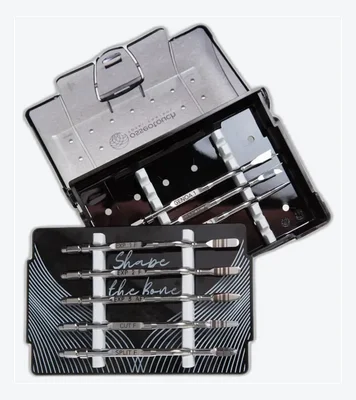
 Ridge Expansion Kit Progressive instruments for horizontal ridge expansion without bone removal. Discover more →
 OSSEOTOUCH · Magnetic Mallet System
Kit Easy In 6
Working the mandible with the Magnetic Mallet
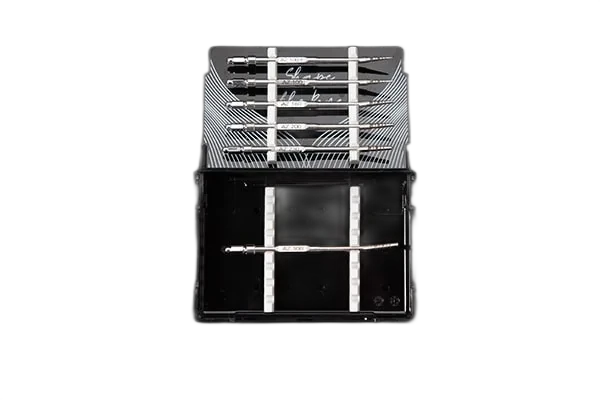
Mandibular Osteotome Kit · six 20° angled osteotomes for D2-D3 bone preparation
Six 20° angled osteotomes — AZ 100P pilot through AZ 300 — designed by Dr. Arduini and Dr. Zuccaro for posterior mandibular implants and full-arch six-implant workflows. Bone distraction using MAGNETODYNAMICS, no rotary cutting.
Mandibular preparation·D2-D3 bone·20° angulation·Six osteotomes·MAGNETODYNAMICS·Bone distraction·Immediate loading·Full-arch six-implant·Mandibular preparation·D2-D3 bone
Let’s make this useful to you · Easy In Kit
What would you like to understand?
Start with a question. Explore the details here, or ask our team about the part that matters to you.
No appointment needed to ask.Get clear on Magnetic Mallet.
Ask your questions, understand how it works and explore the differences between instruments and kits.
Talk to a product specialist Choose a day and time that work for you.What does this include?
See the instruments and their descriptions together, before comparing configurations or asking about a particular component.
How is it used?
Start with the original demonstration or protocol on this page. Then ask us about the instrument or step you would like explained.
Where would I start?
You do not need to decide on a configuration yet. Tell us which procedures you want to explore and what you already know about Magnetic Mallet.
01 The clinical problem
Rotary drills
fight the dense mandible
Dense D2 and D3 mandibular bone resists rotary cutting. The blade scrapes the bone, generates friction heat, and demands continuous high-volume irrigation to stay safe. Posterior sites add a second problem: the cheek, the ramus, and the buccal corridor restrict access — straight instruments can't reach where they need to with the right insertion axis.
02 The Easy-In approach
20° osteotomes
made for the mandible
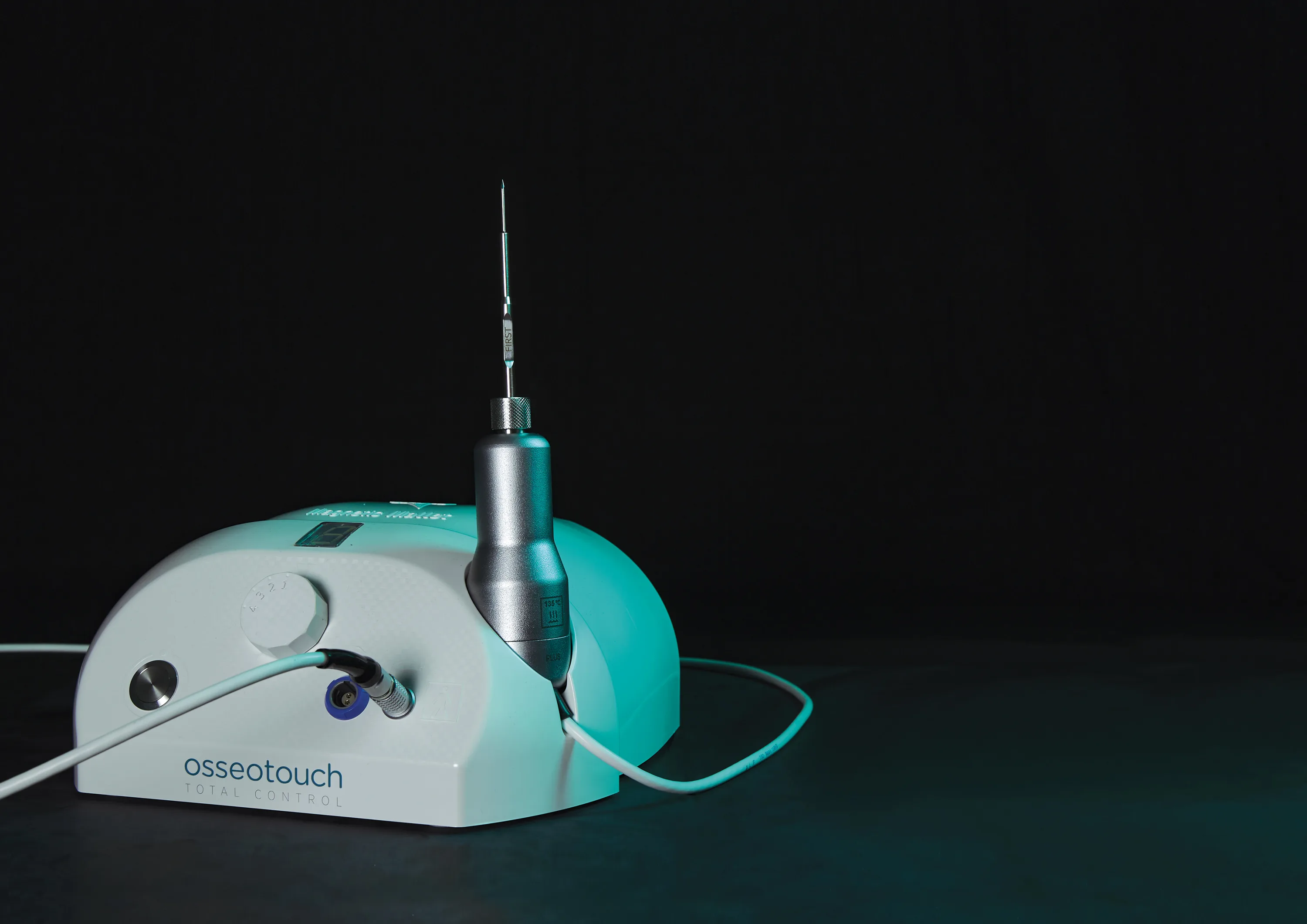
Six 20° angled osteotomes advance through 50-microsecond impulses generated by MAGNETODYNAMICS technology delivered by the Magnetic Mallet. Bone is distracted laterally rather than cut, the osteotomy wall is preserved, and the angled geometry reaches posterior mandibular sites without compromised insertion axes. Designed by Dr. Arduini and Dr. Zuccaro around the full-arch six-implant mandibular workflow.
02 Six benefits
Six benefits
of mandibular preparation using MAGNETODYNAMICS
One handpiece. Six osteotomes. Six reasons site preparation in dense mandibular bone becomes faster, more predictable, and reaches sites rotary protocols struggle with.
20° angulation for posterior access
Each osteotome is angled at 20° — geometry-matched to the posterior mandibular corridor. The working tip aligns with the site axis while the handpiece body clears the cheek and ramus.
Bone distraction, not subtraction
Impulses generated by MAGNETODYNAMICS technology push the bone laterally rather than cutting it away. The osteotomy wall matrix is preserved — typically supporting the high seating torque associated with immediate-loading workflows.
Avoids rotary friction heat
The osteotomes do not rotate. The non-rotary action avoids the friction heat rotary drills generate in dense D2-D3 bone — and the high-volume irrigation cycle that comes with it.
Calibrated, operator-independent force
The 50-microsecond impulse is delivered by the device, not by hammer strikes from an assistant. Insertion energy is consistent from the first osteotome to the sixth — and stays below the threshold typically perceived as vibration.
Six progressive diameters
From AZ 100P pilot through AZ 300 — narrow-platform to wider-platform implants covered by a single kit. The surgeon dials in the final diameter precisely, without changing kits mid-case.
Designed by Dr. Arduini & Dr. Zuccaro
Diameter sequence and 20° geometry come from Dr. Luca Arduini and Dr. Daiana Zuccaro, Italian implantologists with active practice in full-arch and immediate-loading mandibular cases.
03 Easy-In at work
Clinical case
in real practice
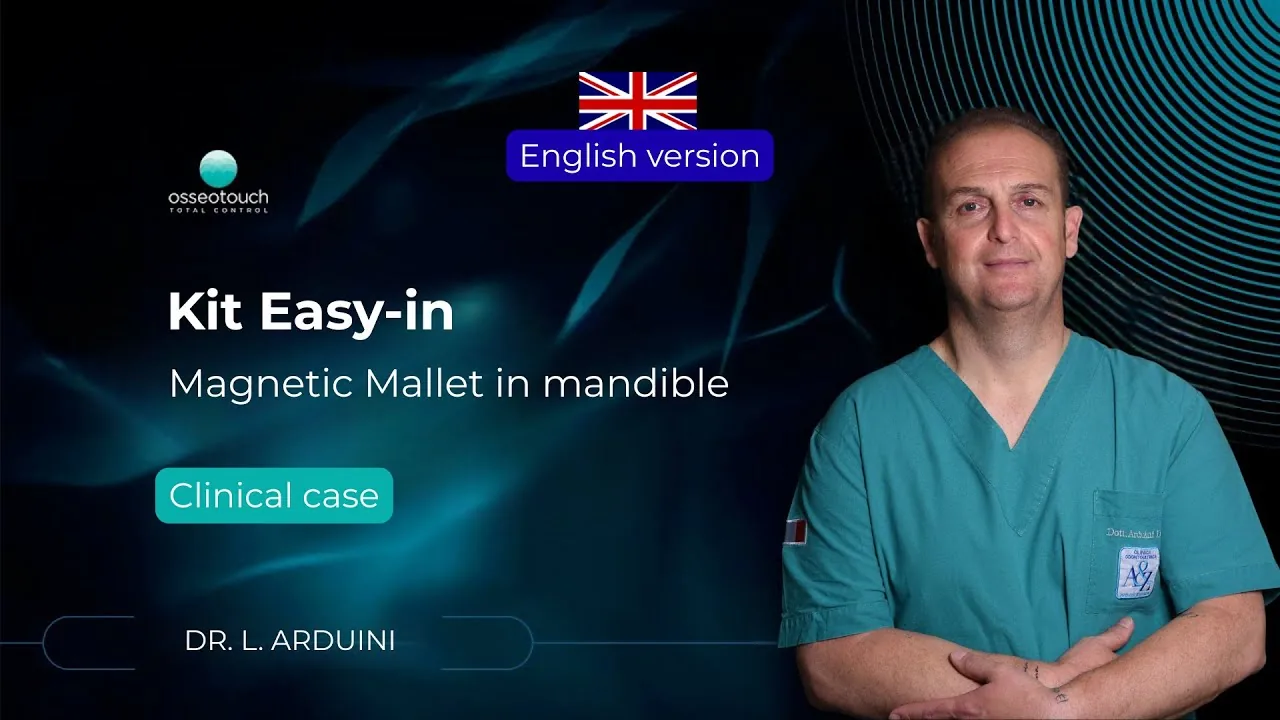
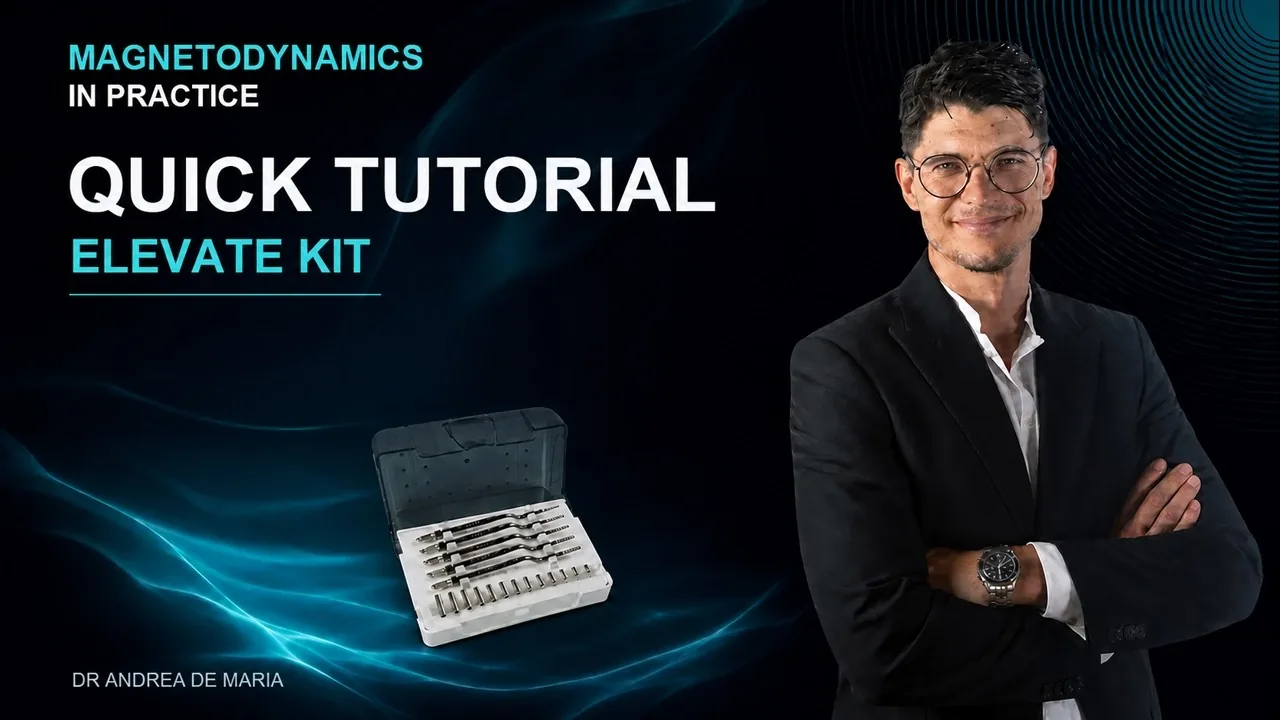
Documented clinical case — Dr. Luca Arduini using Kit Easy In 6 on a posterior mandibular preparation with the OSSEOTOUCH Magnetic Mallet, including immediate-loading workflow.
Bring MAGNETODYNAMICS to mandibular preparation
to your practice
Talk with our specialist to evaluate Kit Easy In 6 for your mandibular case mix, check compatibility with your existing Magnetic Mallet handpiece, or ask a question about the instruments.
For a fast reply, message us on WhatsApp — we usually answer within minutes. Email and form requests may take a little longer.
04 The Surgical Kit · 6 osteotomes
Six osteotomes
one mandibular sequence
AZ 100P pilot through AZ 300 — six 20° angled osteotomes covering the typical mandibular implant diameter range. The kit pairs with a Magnetic Mallet handpiece via the standard threaded coupling.
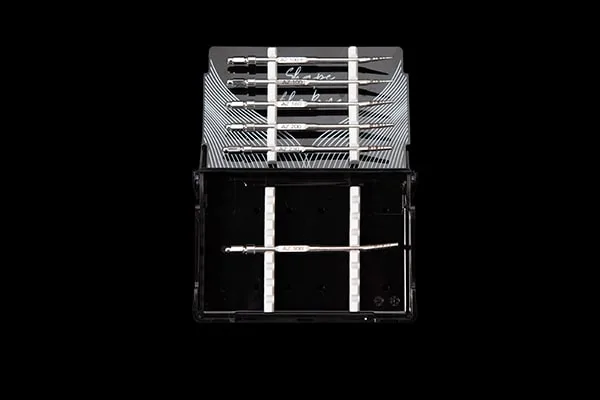
Six osteotomes (one set)
Six 20° angled osteotomes in a surgical-grade autoclavable box. Each osteotome threads onto the Magnetic Mallet handpiece via the standard threaded coupling. Reusable case after case with standard autoclave sterilization.
AZ sequence — pilot to AZ 300
| Code | Role | Use in sequence |
|---|---|---|
| AZ 100P | Pilot | Marks entry point and establishes the insertion axis in the mandibular crest |
| AZ 100 | Initial expansion | First diameter step after the pilot |
| AZ 160 | Intermediate expansion | Progressive lateral distraction toward planned implant diameter |
| AZ 200 | Working expansion | Common final preparation diameter for narrow-platform implants |
| AZ 230 | Wider expansion | Standard-platform implants in mandibular sites |
| AZ 300 | Final expansion | Wider-platform implants when planned by the surgeon |
Surgical-grade stainless steel, autoclavable. Compatible with new-generation Magnetic Mallet handpieces; the Plus handpiece is recommended for dense D2-D3 mandibular bone.
U.S. orders · available now
Order Kit Easy In 6 through OSSEOTOUCH LLC — fast nationwide delivery, product information from our team.
05 Clinical applications
Four clinical applications
one mandibular workflow
Kit Easy In 6 covers the mandibular implant scenarios where rotary preparation is most challenging — same six-osteotome sequence, same principle of MAGNETODYNAMICS, same handpiece.
Posterior mandibular implants
Sites 36-37, 46-47 — dense D2/D3 bone, restricted buccal corridor, lingual concavity. The 20° angulation reaches distal sites with the correct insertion axis; bone distraction supports the seating torque needed for stable placement.
Immediate-loading workflows
Lateral bone distraction preserves the osteotomy wall matrix rather than removing it. In dense D2-D3 sites this commonly supports the seating torque range typically associated with immediate-loading workflows. Final stability is always a clinical assessment.
Narrow ridges in the mandible
In suitable cases, osteotomes designed for use with MAGNETODYNAMICS can gradually distract a narrow mandibular ridge as the diameter sequence progresses. May avoid or postpone formal ridge-splitting or bone-grafting in selected scenarios.
Full-arch six-implant protocols
Six osteotomes for six implants. The 20° angulation handles distal sites without changing instruments; advancement using MAGNETODYNAMICS reduces per-site preparation time across the full surgical session.
U.S. orders · ships nationwide
Add Kit Easy In 6 to your mandibular workflow — order through OSSEOTOUCH LLC, fast nationwide delivery.
06 Frequently asked questions
Common questions
about Kit Easy In 6
What is Kit Easy In 6 and what is it used for?
Kit Easy In 6 is a six-osteotome mandibular set designed by Dr. Luca Arduini and co-designed by Dr. Daiana Zuccaro for implant site preparation in dense D2 and D3 mandibular bone using the OSSEOTOUCH Magnetic Mallet. The six 20° angled osteotomes (AZ 100P pilot, AZ 100, AZ 160, AZ 200, AZ 230, AZ 300) progressively expand the osteotomy through bone distraction, replacing rotary subtraction in posterior mandibular sites and full-arch six-implant mandibular workflows.
Why six osteotomes specifically?
Six osteotomes match a clinical reality: the typical full-arch six-implant mandibular case places six implants, and the diameter sequence (pilot through AZ 300) covers narrow-platform to wider-platform implants without changing kits mid-case. The number and the diameter spread are set by the kit's designers, Dr. Arduini and Dr. Zuccaro, based on full-arch mandibular workflow experience.
Why 20° angulation?
Posterior mandibular sites cannot reliably accept a straight insertion axis: the cheek, the buccal corridor, and the ramus geometry restrict access. A 20° angled osteotome aligns the working tip with the site axis while keeping the handpiece body clear of soft tissues, allowing posterior sites to be prepared with the correct vertical axis.
How does Easy In 6 compare to rotary drills?
Rotary drills cut and remove bone, generating friction heat in dense D2/D3 mandible. Easy In 6 osteotomes do not rotate — they advance through impulses generated by MAGNETODYNAMICS technology and laterally distract the bone, preserving the osteotomy wall matrix and avoiding rotary heat. Lateral distraction also commonly supports the higher seating torque used in immediate-loading workflows.
Can Easy In 6 be used for immediate loading?
Easy-In supports immediate-loading-friendly preparation by preserving the osteotomy wall and producing a slightly under-prepared site. Whether immediate loading is appropriate is always a clinical decision based on the achieved primary stability, the bone quality, the implant system, and the prosthetic plan — not on the kit alone.
Is Easy In 6 only for the mandible?
Yes — by design. The 20° angulation, the diameter sequence, and the entire kit philosophy are mandibular. Maxillary preparation typically requires different geometry. For osseodensification in the maxilla we recommend other dedicated kits in the OSSEOTOUCH catalog.
Is Easy In 6 compatible with my Magnetic Mallet handpiece?
Compatible with new-generation Magnetic Mallet handpieces; the Plus handpiece is recommended for dense D2-D3 mandibular bone. Each osteotome threads onto the handpiece via the standard threaded coupling and is advanced by the impulse generated by MAGNETODYNAMICS technology. No additional accessory is required beyond the kit and the handpiece.
What is the FDA regulatory status of the Magnetic Mallet system?
The OSSEOTOUCH Magnetic Mallet is registered with the U.S. FDA under Establishment Registration 3011922183 and product codes EIS · KDG · GEY (21 CFR 872.4565 / 878.4820). U.S. Agent: Thema USA, New York. The Easy-In osteotomes thread onto new-generation Magnetic Mallet handpieces and are fully autoclavable.
Ready to get started?
Talk with our team — we'll help you evaluate Kit Easy In 6 for your mandibular workflow and clarify your questions about the instruments.
Book a clinical call
Pick a date and time. We will contact you to discuss your workflow.
Email our specialists
cs@osseotouch.com
Direct chat with our team.
U.S. ordersBuy online
Order Kit Easy In 6 through OSSEOTOUCH LLC — fast nationwide delivery and product information from our team.
Kit Easy In 6 is part of the OSSEOTOUCH Magnetic Mallet system, manufactured by Meta Ergonomica S.r.l. (Italy). United States: registered and listed with the U.S. FDA under Establishment Registration 3011922183, product codes EIS · KDG · GEY (Class I, 21 CFR 872.4565 / 878.4820), 510(k)-exempt and subject to general controls. U.S. Agent: Thema USA, New York. ISO 13485. Use restricted to qualified dental professionals according to the instructions for use.
Evidence on this technique
Peer-reviewed research on surgery based on MAGNETODYNAMICS. The studies concern the technique, not this single instrument.
- Influence of implant site preparation method on three characteristics: magnetodynamic mallet versus conventional drill
- Effect of implant macro-design and magnetodynamic surgical preparation on primary implant stability: an in-vitro investigation
- Biomolecular, Histological, Clinical, and Radiological Analyses of Dental Implant Bone Sites Prepared Using Magnetic Mallet Technology: A Pilot Study in Animals
OSSEOTOUCH PEER-TO-PEER
See what your peers are doing with Magnetodynamics
Discover how they use it in clinical practice, what advantages they observe and connect directly with them.
75+ resources